

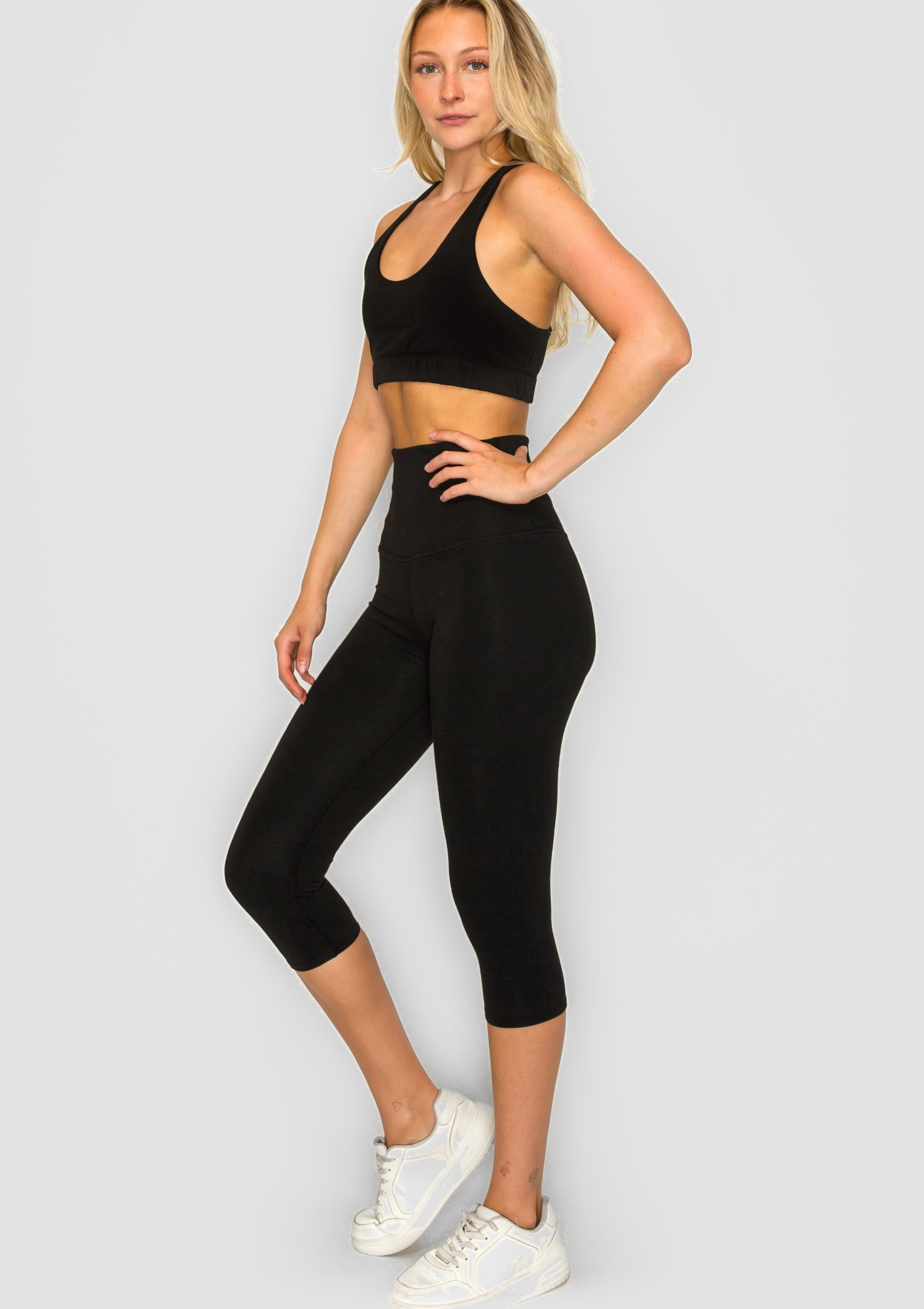
Does Organic Cotton Shed Microplastics?
The short answer: Organic cotton is not a plastic, so the fibers it sheds are not microplastics. But most cotton activewear is not 100% cotton. PuraKai's activewear fabric is 92% organic cotton and 8% spandex, and spandex is a plastic. That 8% does shed. Any brand selling stretch activewear while claiming zero microplastic shedding is either not counting the stretch fiber or has not tested for it.
Microfiber and microplastic are not the same word
Every fabric sheds. Cotton, linen, wool, hemp, polyester, nylon, all of them release short fiber fragments during wear and washing. Those fragments are called microfibers.
A microfiber counts as a microplastic only if the fiber itself is made of plastic. Cotton fragments are cellulose. Wool fragments are protein. Polyester, nylon, acrylic and spandex fragments are synthetic polymers, which makes them microplastics.
So the useful question is not whether a fabric sheds. Every fabric does. The question is what the shed material is made of, and what happens to it after it goes down the drain.
Yes, organic cotton sheds too
Cotton is not a low-shedding fiber, and the research does not flatter it on this point.
A 2021 study in PLOS ONE measured fiber loss from real consumer garments in domestic laundry. Natural fibers released roughly 165 milligrams per kilogram of textile washed. Mechanically treated polyester released roughly 161 milligrams per kilogram. By mass, the natural fiber samples shed slightly more than the polyester samples.
That figure tends to go missing from sustainable fashion marketing. We would rather publish it. The argument for natural fiber does not depend on shedding less, and a brand that pretends otherwise is not reading its own sources.
The difference is what happens next
Shedding is the start of the story. Persistence is the rest of it.
Zambrano and colleagues, writing in Marine Pollution Bulletin in 2019, put laundered microfibers into simulated aquatic conditions and tracked them for 243 days. Cotton biodegraded by roughly 76%. Rayon reached roughly 62%. Polyester came in under 5%.
A cotton fragment in a river is a short-lived piece of cellulose. A polyester fragment in the same river is still there years later, and it keeps breaking into smaller pieces rather than going away. That gap, not the shedding rate, is the real environmental case for natural fiber.
The 8% we cannot claim our way out of
PureFlex, the fabric in PuraKai's leggings, shorts and sports bras, is 92% GOTS-certified organic cotton and 8% spandex. The spandex is in there for a plain mechanical reason: organic cotton on its own stretches out and stays stretched. The 8% is what returns the garment to shape after a squat.
Spandex, sold in Europe as elastane, is a segmented polyurethane. Under the US definition a fiber must be at least 85% polyurethane by weight to be called spandex. Polyurethane is a plastic. A spandex fragment in wastewater is therefore a microplastic, in exactly the same sense a polyester fragment is.
Published research has measured this at our precise blend ratio. A 2023 study in Science of the Total Environment tested cotton and elastane blends including 92/8. The results:
- 92/8 cotton/elastane released 46.56 microfibers per square centimeter, more than double the 21.04 released by a 98/2 blend.
- In the first wash, about 19.6% of the fibers released from the 92/8 fabric were elastane rather than cotton.
- By the fourth wash, that share had climbed to roughly 36%, because the cotton fraction sheds fastest early while the elastane keeps fragmenting.
One caveat we will state rather than bury: that study tested a fabric with the same fiber ratio as ours, not our fabric. We have not put PureFlex through this specific test. We are citing the closest published evidence, and we will say so plainly instead of quietly borrowing someone else's numbers as if they were our own.
Read straight, the finding is this. Roughly one in five fibers a pair of 92/8 organic cotton leggings sheds in an early wash is plastic, and that proportion rises as the garment ages. We sell 92/8 leggings. So that applies to us.
Why we still make the fabric this way
The alternative to 8% spandex is not a plastic-free legging. It is a legging that bags at the knee after twenty minutes and gets thrown out in a season. A garment that fails early is replaced early, and replacement is where most of the footprint lives.
The competing option in the market is not cotton without spandex either. It is polyester or nylon with spandex, where the entire garment is plastic instead of 8% of it. Compared against a conventional synthetic legging, a 92/8 organic cotton legging moves the plastic fraction from around 100% to around 8%, and the shed cotton portion biodegrades. That is a real reduction. It is not zero, and we are not going to call it zero.
If you want a genuinely plastic-free option, the honest answer is to skip stretch fabric entirely. PuraKai's Pure line is 100% organic cotton with no spandex at all, which means nothing it sheds is a microplastic. It also does not stretch and recover the way activewear needs to. That is the trade, stated in both directions.
What actually reduces shedding
Most of the shedding a garment will ever do is controlled by how it is laundered, not by what you buy.
- Wash less often. Activewear worn for an hour rarely needs a full cycle. Airing out between wears removes the single largest source of fragmentation.
- Wash cold, on a gentle cycle. Heat and agitation are what break fibers loose.
- Run full loads. More water per garment means more friction per garment. A packed drum sheds less per item than a half-empty one.
- Skip the dryer. Tumble drying is harder on fiber than washing is. Line drying also extends the life of elastic fibers.
- Use a filter bag or a washing machine filter. These capture a meaningful share of released fiber. They do not capture all of it, and anyone telling you they do is overselling.
None of this requires buying anything. Three of the five steps save money.
Where PuraKai stands
We started in 2012 as an ocean conservation project before we made a single garment, and we have supported ocean conservation every year since. The line from a washing machine to a river to the ocean is the reason this company exists, which makes it the last subject we are willing to be vague about.
So the position is: our organic cotton does not shed microplastics, our 8% spandex does, we have published the number we have and labeled the one we have not measured ourselves, and we would rather lose a sale to that honesty than win one by claiming a zero we cannot support. The same standard governs how we handle PFAS testing and how we describe our GOTS-certified organic cotton.
You can see the fabric in our organic cotton leggings and the rest of our women's organic cotton activewear, all of it designed, cut, sewn and finished in our own Los Angeles facility. More on why we work that way is in our story.
Frequently Asked Questions
Does 100% organic cotton clothing shed microplastics?
No. A fabric that is 100% cotton contains no synthetic polymer, so the fibers it sheds are cellulose rather than plastic. It still sheds microfibers, and by mass it can shed as much as polyester does. The difference is that cotton fragments biodegraded by roughly 76% over 243 days in published aquatic testing, while polyester stayed under 5%.
Is spandex a microplastic?
Yes. Spandex, also sold as elastane, is a segmented polyurethane and must be at least 85% polyurethane by weight to carry the name. Polyurethane is a plastic, so spandex fragments released in the wash are microplastics. This applies to every stretch garment on the market, including ours, whatever the rest of the fabric is made of. More detail is in our explainer on organic cotton versus synthetic workout clothes.
Do organic cotton leggings shed less than polyester leggings?
Not necessarily by count or by mass, and the honest answer depends on which measure you use. A 92/8 organic cotton legging sheds a mix of cotton and spandex fibers, and published testing at that ratio found roughly one in five released fibers was elastane in an early wash. A polyester legging sheds fibers that are essentially all plastic. The meaningful reduction is in the plastic fraction and in what biodegrades afterward, not in the raw shedding rate. For the health side of the same comparison, see is polyester bad for you.

Leave a comment
This site is protected by hCaptcha and the hCaptcha Privacy Policy and Terms of Service apply.