

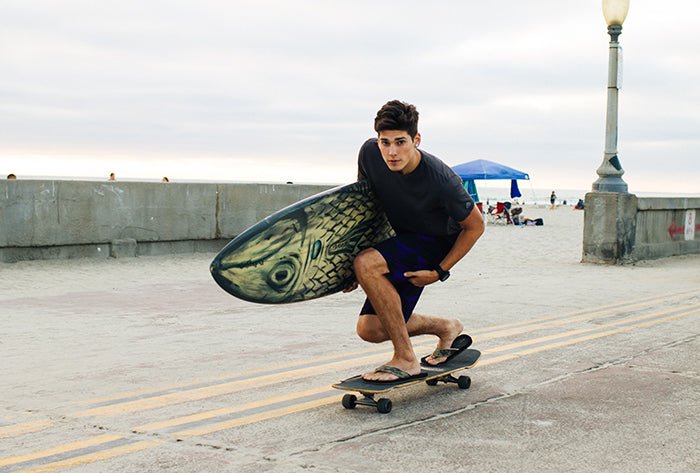
Surf Clothes and Surfer Style, the PuraKai Way
The short answer: Surfer style, the PuraKai way, is relaxed, useful, ocean-minded organic cotton clothing for the hours before and after the water. PuraKai does not make wetsuits, rash guards, boardshorts, or other technical surf gear. We make beach-to-town layers, organic cotton activewear, and organic cotton basics for people who feel at home near the ocean.
That distinction matters. A wetsuit has to insulate in cold water. A rash guard has to handle repeated saltwater exposure. Boardshorts need to dry fast and stay secure in the surf. Those are technical jobs, and PuraKai does not pretend otherwise. Our idea of surf clothes starts once the session ends: a soft layer for the walk home, a comfortable set for an early coffee, or an easy outfit for the rest of the day.
A Father, a Daughter, and the Ocean
PuraKai began in 2012 with a dad and daughter who both surfed. The ocean was part of family life, not a marketing theme. In an early founder post, the dad described being in, on, and under the water as a lifelong obsession. Surfing, freediving, fishing, spearfishing, and stand up paddling shaped how he saw the world.
One of those early accounts began with a quick paddle in small San Diego surf. He was still learning to stand up paddle, but years of reading waves helped. A dolphin jumped from a wave in front of him, then surfaced again as the pod moved close by. The moment brought him back to the simple reason people enter the water: to play. That session produced an early PuraKai line, "The ocean is our playground."
The business idea had been waiting much longer. In another 2012 post, the founder wrote that PuraKai was a dream he had carried for more than ten years. He had woken at night with ideas but had been afraid to take the risk. His conclusion was plain: tomorrow was not guaranteed, so that day was the day to take the next step.
The name took a few tries. The working name, Ocean Watermen, felt too narrow. It centered men and suggested a limited range of ocean sports. After rounds of calls with friends, family, advisers, and a patient designer, PuraKai won. Pura means pure in Spanish. Kai means ocean in Hawaiian. Together, the name means Pure Ocean.
That is the real origin of PuraKai surf fashion. It came from a father and daughter who surfed, a family life shaped by the water, and a decision to build something bigger than profit. The company remains a small family business. It has no venture capital and no private equity.
What Surfer Style Means Here
Surfer style clothing does not need fake team graphics or a claim that every wearer charges heavy waves. It can be practical and quiet. It should feel easy after saltwater, fit into a normal day, and reflect some care for the places that make surf culture possible.
For PuraKai, that means organic cotton tees and tanks, fitted organic cotton activewear, and relaxed organic cotton joggers. These are clothes for checking the break, walking the beach, stretching before a session, warming up afterward, driving home, or heading into town. The goal is not to replace technical gear in the water. It is to make the rest of the day comfortable.
A fitted set keeps the look simple. Start with the bestselling PureFlex High Waist Leggings or High Waist Pocket Leggings and pair them with the organic cotton Racerback Sports Bra, Reversible Pivot Top, or Cami Crop Top. In warm weather, the High Waist Shorts and Pocket Shorts work with the same fitted tops. Capri Leggings offer another easy length. For a relaxed rest-day outfit, keep the proportions together: a Pure 100% organic cotton tee with Pure 100% organic cotton joggers. Keep tops fitted; the leggings are meant to be seen, not covered.
Color can nod to the coast without turning the person wearing it into a costume. So can an unfussy silhouette. The strongest surfer style often looks like what it is: clothing chosen by someone who wants fewer changes between beach, car, cafe, and home.
What PuraKai Actually Makes Now
PuraKai now makes organic cotton activewear and organic cotton basics. The two fabric families serve different needs. PureFlex is 92% organic cotton and 8% spandex. The small spandex share gives fitted leggings, shorts, tops, and sports bras the stretch and recovery those shapes need. Pure is 100% organic cotton. It is used for relaxed pieces such as tees and joggers that do not need activewear compression.
Both families use GOTS-certified organic cotton at the fabric level. That wording is deliberate. PuraKai does not claim that the company itself earned GOTS certification. The GOTS organic cotton guide explains what the standard covers and how fiber and fabric claims differ.
These materials have real trade-offs. Cotton is absorbent and comfortable for everyday wear, but a wet organic cotton layer dries more slowly than many synthetic technical fabrics. That is one reason PuraKai does not market its organic cotton clothing as in-water surf gear. For dry land, easy movement, and the transition from beach to town, a soft cotton-majority fabric can make sense. The detailed organic cotton versus synthetic workout clothing guide covers the performance differences.
For the current range, start with the women's organic cotton activewear collection. The organic cotton leggings collection includes the two most popular products, High Waist Leggings and High Waist Pocket Leggings.
From Beach Values to Los Angeles Production
The early founder posts kept returning to one question: how could clothing be made with fewer negative consequences? The founder spent months speaking with farmers, cotton gins, knitters, and sewing facilities. He wanted to visit the places involved and understand the people and processes behind the garment. The ambition was never perfection. It was to make better choices, state their limits, and keep improving.
That idea is now concrete. PuraKai owns its Los Angeles production facility. Design, cutting, sewing, and finishing happen under one roof in the company's own building. Los Angeles partners handle knitting and garment dyeing. Every garment-making step stays in Los Angeles, and most steps are in-house. The cotton itself is grown in Texas, Turkey, and India, so PuraKai does not make a single-origin or solely USA-grown claim.
Local production is the first test PuraKai applies to sustainable clothing. It gives the family direct oversight of the production floor and the people making the garments. It also avoids sending finished garments through an overseas production chain. Read the full account of why PuraKai makes everything in Los Angeles.
The same proof-first approach applies to chemistry. PuraKai paid for independent PFAS testing through Applied Technical Services and publishes the laboratory report. Applied Technical Services, an independent testing laboratory, tested our organic cotton leggings fabric and found no PFAS detected, measuring total fluorine below 2 parts per million against a current industry threshold of 100 ppm. The PFAS testing page explains the result and what it covers in plain language.
Ocean Action, Not Surf Cosplay
The founder's early sustainability philosophy was unusually candid. He wrote that PuraKai would not do everything perfectly and should not make purity claims it could not support. A person could drive an SUV, take a boat out, garden, compost, and still try to make better choices. Life was rarely black and white. The honest goal was progress with proof.
That view still fits. Organic cotton surf clothes do not clean a beach by themselves. A wave graphic does not protect marine life. Real ocean-minded style asks where a garment was made, what it contains, how long it will be used, and what the company does beyond a slogan.
PuraKai has supported ocean conservation since its founding by donating a portion of revenue. The history also includes hands-on work. The founder archive records a community beach cleanup invitation, not a polished campaign created years later.
Two early essays remain live as records of that beginning. The Launch of PuraKai is the original 2012 account of plastic pollution, the meaning of PuraKai, and a mission to give back. My Conversation with a Seal tells the personal moment that pushed the founder from taking from the ocean toward giving more. They are imperfect, personal documents from the founder's archive. That is why they matter.
We still believe surfer style starts with a relationship to the water. Our part is specific: make useful organic cotton clothing in our own Los Angeles facility, publish the proof we have, admit the limits, and keep supporting the ocean that started the company.
Frequently Asked Questions
Does PuraKai make technical surfwear?
No. PuraKai does not sell wetsuits, rash guards, boardshorts, or other technical surf gear. It makes organic cotton activewear and organic cotton basics for beach-to-town wear, movement, travel, and the hours before and after surfing.
What do surfers wear after surfing?
Comfort and the weather usually lead the choice. After changing out of wet gear, easy options include an organic cotton tee and joggers, or organic cotton leggings or shorts with a fitted top or sports bra. Bring a warmer layer if the wind or evening temperature calls for one. Do not rely on organic cotton as insulation while it is wet.
What makes organic cotton right for beach-to-town clothing, and where is PuraKai made?
Organic cotton offers a soft, absorbent fabric for relaxed wear and everyday movement. It is not the fastest-drying choice for technical water use, which is why PuraKai describes it honestly as beach-to-town clothing. PuraKai garments are knit, cut, sewn, and dyed in Los Angeles. Design, cutting, sewing, and finishing happen in the company's own facility, while local Los Angeles partners handle knitting and garment dyeing.


Leave a comment
This site is protected by hCaptcha and the hCaptcha Privacy Policy and Terms of Service apply.